
Why Vocal Media's Sponsored Content Isn't a Marketplace (And What That Means for You)
Jotmill · August 2, 2026
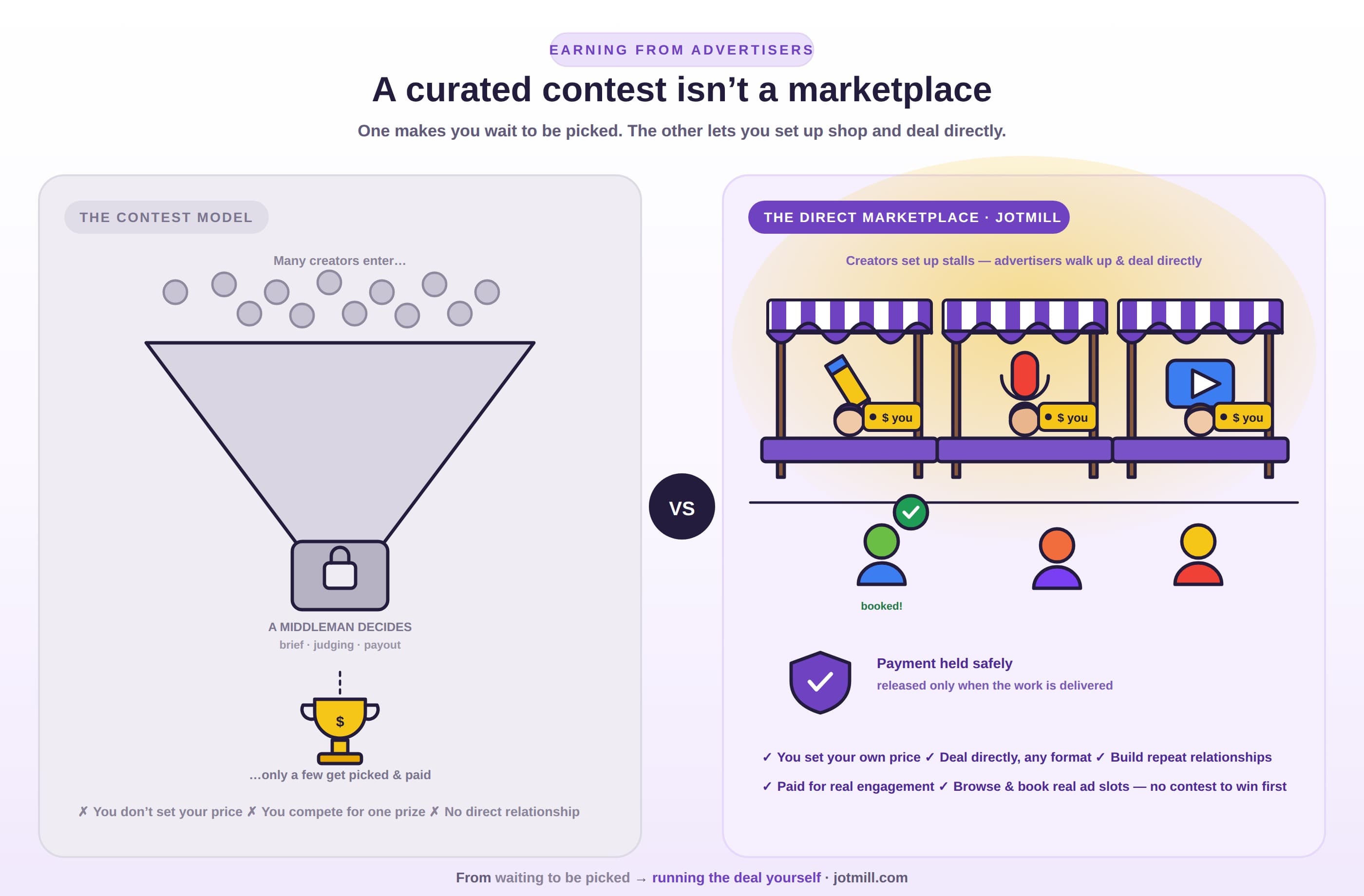
Quick Answer: Vocal Media runs sponsored content through brand-backed "Challenges" that Vocal's own team picks and manages. Creators don't set their price, and advertisers don't choose their creator. That's not a marketplace, it's a curated program. If you want to pick your own partner, agree on your own price, and get paid without waiting on a middleman, you need a Vocal Media alternative built as an actual marketplace, where creators and advertisers deal with each other directly.
What "Sponsored Content" Actually Means on Vocal Media
Vocal Media is a storytelling platform. Writers publish stories, essays, and articles across categories like fiction, film, and lifestyle. Some creators also post short video or audio pieces. Readers browse by category, and creators earn money mainly through reads and platform payouts, plus occasional branded writing challenges with cash prizes.
Sponsored content on Vocal usually comes through something called a "Challenge." A brand backs a themed writing prompt. Vocal's team sets the rules, invites submissions, and often judges or ranks the entries. Winners get paid, sometimes based on story performance, sometimes based on being selected. Thousands of writers might enter a single challenge; only a few get paid.
This sounds like sponsorship. It functions differently. The brand isn't picking a creator to work with directly. The creator isn't setting a price for their work. Vocal sits in the middle of the entire process, from the brief to the judging to the payout.
That's the core difference between a sponsorship program and a real marketplace. In a marketplace, two sides find each other and agree on terms. In a sponsorship program, a platform curates the whole experience on their behalf. Whichever route a creator uses to earn sponsored income, it's worth remembering that any paid partnership should follow the FTC's (USA Federal Trade Commission) disclosure guidelines for sponsored content, so readers always know when money changed hands a rule that applies no matter which platform a creator publishes on.
Why Vocal Media's Model Isn't a Real Marketplace
No Direct Deals Between Brands and Creators
On Vocal, a brand doesn't scroll through creator profiles, review past work, and reach out with an offer. Instead, the brand hands a brief to Vocal, and Vocal turns it into a public challenge. Creators respond to a prompt, not to a specific advertiser's pitch. There's no negotiation, no back-and-forth, no direct relationship forming between the two sides.
Creators Don't Set Their Own Terms
In a true marketplace, a creator lists their rate, or bids on a campaign with a price they choose. On Vocal's Challenge model, the payout structure is decided ahead of time by Vocal and the sponsoring brand. A creator can enter or skip a challenge, but they can't counter-offer, adjust scope, or price their own work the way a freelancer would on an open marketplace.
Sponsorship Runs Through Vocal's Central Team, Not You
Every step, from who gets invited to how winners are judged, runs through Vocal's internal process. That's not a criticism of the model some creators like a curated, low-effort way to enter a paid challenge. But it does mean Vocal is the decision-maker, not the creator and not the advertiser. Neither side is really running the deal.
A real ad marketplace, by contrast, works closer to a farmers market: sellers set up stalls, buyers walk around, compare prices, and buy directly from the seller they trust. No middleman decides who gets a table or who wins a prize. An online ad marketplace works the same way advertisers browse open slots inside real content, see who the creator is and how many people read their work, then book the slot at a clear price, without needing an agency or a contest to win first.
What This Means for Creators on Vocal Media
If you're a creator on Vocal, this setup has real limits.
• You can't pitch a brand you admire directly. You wait for a challenge to appear.
• You don't control your price. The challenge terms are already set.
• You compete against many other entries for the same prize pool, instead of being hired for your specific voice.
• You have no way to build a repeat relationship with a specific advertiser over time.
None of this makes Vocal a bad place to publish stories. It just means sponsored income depends on timing and luck, not on your own outreach or reputation.
What This Means for Advertisers Working With Vocal Media
Advertisers face a mirrored set of limits.
• You can't choose the exact creator whose audience fits your product.
• You can't set specific delivery requirements the way you would in a direct booking.
• You're trusting Vocal's judging process to surface content that fits your brand, rather than reviewing and selecting a creator yourself.
• You get less visibility into who is actually creating your sponsored content until it's already done.
For a brand testing creator marketing for the first time, that's a lot of control handed over to a third party.
Signs You've Outgrown Vocal Media's Sponsored Content Model
You might be ready for a Vocal Media alternative if:
• You have a steady group of readers, but no way to monetize them beyond per-read earnings
• You've tried entering sponsored challenges, but you rarely win
• You want to pitch brands yourself but have no built-in tools to show your audience data
• You publish in more than one format like writing plus a podcast and want one home for all of it
• You want to be paid for how long people actually engage with your work, not just how many people click
• You want a repeat relationship with a specific advertiser, not a one-off contest entry
If two or more of these sound like you, a plain publishing platform is no longer enough. You need something built around direct deals, not contests.
What an Actual Creator-Advertiser Marketplace Looks Like
Direct Deals, Not Curated Placements
A real marketplace lets both sides act on their own behalf. An advertiser can browse a creator's existing content, check their audience, and book a slot directly. Or the advertiser can post a campaign brief, and creators who want the work submit their own proposal, price, and delivery plan. Either way, the two sides are choosing each other, not being matched by a third party's internal process.
This is how Jotmill works. Jotmill is a content publishing platform for writers, podcasters, video creators, and visual artists, and it treats advertisers and creators as equal partners, not as entrants in a contest. An advertiser can buy an AD Slot inside a creator's existing content, or post an AD Campaign and let creators bid with their own proposal.
Creators Set Their Own Rates
On a real marketplace, a creator prices their own ad slot based on their audience size, engagement, and format. If an advertiser posts a campaign instead, the creator submits a proposal with their own rate attached. There's no fixed prize pool split among entries. Payment is agreed upfront, between the two people actually doing the deal.
Payment Protection Built Into Every Deal
The part that makes a direct marketplace work at scale is trust. When a creator and an advertiser have never worked together before, someone has to go first. A real marketplace solves this with a secure fund hold: the advertiser's payment is held by an independent third party the moment a deal is booked, and only released to the creator once the work is delivered and verified. Neither side has to take the other's word for it, and neither side has to wait on a curator to release anything.
What to Check Before Choosing a Vocal Media Alternative
Not every alternative fills the same gap. Some platforms simply offer a different way to publish. Others actually solve the marketplace problem. Before you switch, check:
1. Can advertisers browse real ad slots? Look for a platform where advertisers can search live content by topic and see open ad placements, instead of waiting for a contest announcement.
2. Can you see audience authenticity data? A trustworthy alternative should show some proof that readers are real people, not bots; this protects both the creator's reputation and the advertiser's budget.
3. Does it pay for engagement, not just clicks? Pay-per-click models can reward clickbait. Look for platforms that measure how long someone actually spends with your content.
4. Can you publish more than one format? Many writers now also record a podcast or post short videos. A platform that only handles text means you're still juggling several apps and audiences.
5. Can you bring your own email list? If you already have subscribers, look for a platform that lets you import that list and keep talking to your audience, instead of starting over from zero.
6. Is payment protected on both sides until the work is verified? Not just promises actually held and released against delivery.
A platform that answers yes to all six is a marketplace. A platform that answers no to most of them is a curated program wearing marketplace language. That is Jotmill.com.
Where Jotmill Fits In
This is exactly the gap that newer digital publishing platforms are built to close. Jotmill is one example of a content publishing platform designed around this idea. Instead of only rewarding contest winners, Jotmill lets creators publish across formats, including writing, audio, video, and even posters, all from one dashboard.
More importantly, Jotmill treats advertising as an open marketplace, not a side contest. Advertisers can browse content, look at audience authenticity scores, and buy ad slots directly inside a creator's work, or post a campaign that creators can bid on. That's the self-serve ad marketplace that Vocal Media's sponsored content doesn't offer.
Jotmill also pays creators based on how long readers engage with their work, not just clicks, and it lets creators bring an existing email list with them instead of starting from zero. For a writer who has outgrown Vocal Media's per-read and contest system, this kind of Vocal Media alternative is worth a look, especially if direct advertiser deals are the main thing missing.
None of this means Vocal Media is a bad place to write. It simply means Vocal Media and a true marketplace platform solve different problems. If the goal is publishing and slow, steady per-read income, Vocal Media still works. If the goal is turning an audience into direct ad revenue, a platform built for that from the ground up is the better fit.
Who Should Consider a Vocal Media Alternative
Not everyone needs to switch. If you enjoy writing for Vocal's community and occasional challenges are a nice bonus, there's no reason to leave.
But it's worth looking at a Vocal Media alternative if any of this sounds familiar:
• You want sponsored income to be a reliable part of your creator's work, not something you wait for.
• You want to pitch advertisers directly instead of waiting for a themed challenge to open.
• You create video, audio, or visual content and want the same direct-deal option a writer would get.
• You're an advertiser who wants to pick a specific creator and know exactly what you're paying for before you commit a budget.
How to Make the Switch Without Losing Your Audience
Moving platforms feels risky, but it doesn't have to be all-or-nothing. Most creators don't fully leave Vocal Media; they simply stop treating it as their only home and start treating it as one channel among a few.
A practical way to test the switch:
1. Keep your Vocal Media profile active while you test a new platform on the side.
2. Publish your next piece in both places, if the new platform allows it.
3. Import your email list into the new platform so you're not starting from zero.
4. Watch which platform actually turns into paid advertiser interest over a few weeks before deciding where to focus.
This trade-off is what changes for you: as a creator, you go from waiting for an invitation to actively listing your work or pitching advertisers yourself. As an advertiser, you go from trusting a platform's internal judging to reviewing real creators and picking the one whose audience actually fits. You set your own price, and you write your own pitch with more control, in exchange for more responsibility.
How Jotmill’s Direct AD Marketplace Works, Step by Step
It helps to see the actual steps, side by side with the Challenge model. On a direct creator-advertiser marketplace:
1. An advertiser books a slot or posts a campaign. They either buy an AD Slot inside a creator's existing content, or post a brief and let creators bid.
2. Payment moves right away, but it doesn't land in the creator's account yet. It goes into a secure fund hold managed by an independent third party.
3. The creator delivers the agreed work. A blog post, a podcast segment, a video clip, or a sponsored image, depending on the format.
4. The advertiser checks the delivery against what was booked. Format, placement, and timing all get confirmed.
5. Funds are released to the creator once delivery is verified. No invoice chasing, no waiting on a curator's decision.
Compare that to Vocal's Challenge flow: a brand funds a prize pool, Vocal opens a themed prompt, creators submit entries on spec with no guaranteed payout, and Vocal's team picks winners. The creator does the work first, with no advertiser relationship and no set price attached to their specific submission. That's the structural difference between a sponsorship contest and a real marketplace.
Vocal Media vs. Jotmill’s Direct AD Marketplace, at a Glance
• Who picks the creator: Vocal's judging process picks winners. On a marketplace, the advertiser picks the creator, or the creator pitches the advertiser directly.
• Who sets the price: Vocal sets challenge payout terms in advance. On a marketplace, the creator sets their rate or submits their own bid.
• When payment is committed: On Vocal, payout depends on ranking or selection. On a marketplace, payment is committed and held the moment the deal is booked.
• Content formats supported: Vocal is built mainly around written stories, with some video and audio. A true content publishing platform supports writers, podcasters, video creators, and visual artists under one process.
• Relationship over time: Vocal challenges are one-off contests. A marketplace lets a creator and an advertiser work together again on the next campaign, without starting over.
This is the real reason so many creators start searching for a Vocal Media alternative once they've published a few stories and realized sponsored income isn't something they can plan around.
Frequently Asked Questions
Is Vocal Media a marketplace for sponsored content?
No. Vocal Media runs sponsored content through brand-backed Challenges that Vocal's team creates and manages. Creators don't set their own price, and advertisers don't pick a specific creator to work with, so it functions as a curated program rather than an open marketplace.
What is the best Vocal Media alternative for creators who want paid sponsorships?
Look for a content publishing platform that lets creators list their own ad slots or bid on advertiser campaigns with their own price. Jotmill works this way, supporting writers, podcasters, video creators, and visual artists under the same direct-deal model.
Can advertisers choose which creator they work with on Vocal Media?
Not directly. Advertisers sponsor a Challenge topic, and Vocal's process determines which creator entries are featured or paid, rather than the advertiser selecting a specific creator upfront.
How do creators get paid safely when working directly with advertisers?
A trustworthy marketplace holds the advertiser's payment with an independent third party the moment a deal is booked, then releases it to the creator once the work is delivered and verified. This protects the creator from non-payment and the advertiser from paying for work that never happens.
Does Vocal Media pay for sponsored content at all?
Vocal Media mainly pays through branded writing challenges with a cash prize for winners, plus regular pay-per-read earnings. It doesn't offer a self-serve system where any creator can sell an ad slot directly to a brand.
Do I have to give up Vocal Media to try a different platform?
No. Most creators can publish on more than one platform. You can keep your Vocal Media stories live while testing a direct marketplace for sponsored deals, and compare results before deciding where to focus.
What content types work on a direct creator-advertiser marketplace?
A platform built as a true marketplace should support more than just written stories, including podcasts, video, memes, illustrations, and expert commentary, all under the same booking and payment process.
Why are creators searching for a Vocal Media alternative in 2026?
As more advertisers shift budget from traditional media toward creators, they want direct relationships with people whose audience fits their product. A curated challenge model can't offer that, which is pushing both creators and advertisers toward open marketplaces instead.
The Bottom Line
Vocal's Challenge model works for creators who like a curated, low-effort way to enter a paid opportunity. It's not built for creators or advertisers who want to choose their own partner, set their own terms, and know their money or their work is protected before the deal is done. That's the gap a real creator-advertiser marketplace closes, and it's why more creators and advertisers are looking for a direct Vocal Media alternative instead of waiting for the next themed challenge to open.
Sell ad slots on your own terms
List slots on your videos, podcasts, blogs or cartoons, set your own prices, and get paid through a fund-hold that protects you and the advertiser.