
Jotmill vs Substack vs Beehiiv: Who Actually Lets You Sell Ads Yourself?
Jotmill · August 2, 2026
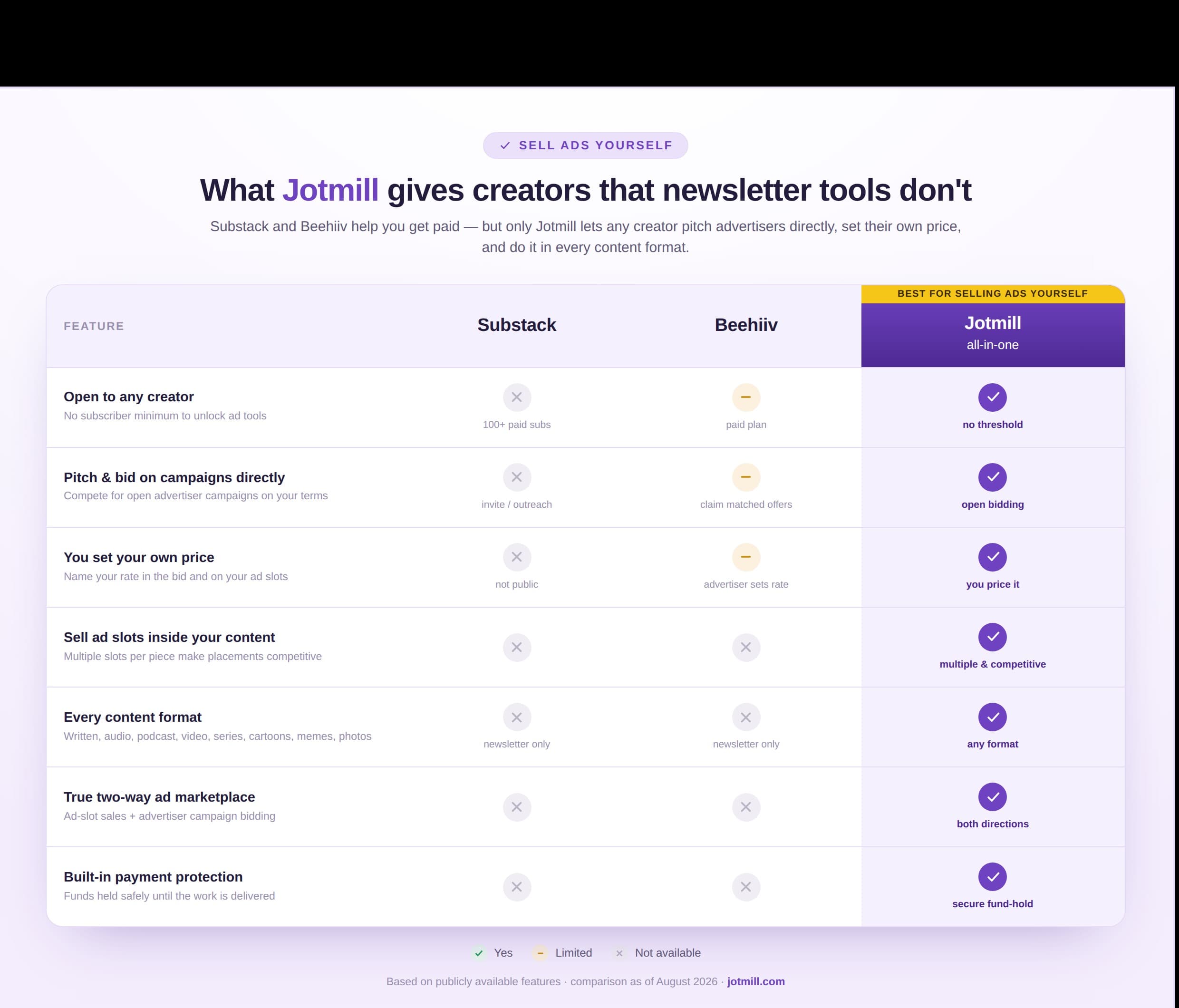
Quick Answer: Substack's sponsorship program is currently limited to top authors with at least 100 paid subscribers, matched with launch-partner brands. Beehiiv gives creators a live marketplace of pre-matched advertiser offers to claim, plus the option to set up their own direct sponsorships. Jotmill takes a different approach: any creator can pitch or bid on open advertiser campaigns directly, with no subscriber minimum required. For creators exploring Substack alternatives, the platform you pick matters more than the newsletter tool itself when direct control over advertiser deals is the priority.
Why This Comparison Matters
Every newsletter creator eventually asks the same question: how do I get paid by advertisers, not just readers? Subscriptions are great, but they cap out. Advertiser deals open a second income stream, and sometimes a bigger one.
The problem is that "monetization" means very different things depending on the platform. Some tools hand you a curated deal. Others hand you a live marketplace. Others expect you to do the pitching yourself. None of these are wrong, but they are not the same, and picking the wrong one for your goals wastes months.
This guide compares Substack, Beehiiv, and Jotmill on one specific question: who actually lets a creator sell advertiser placements themselves, without waiting to be picked?
Substack: How Advertiser Deals Work Today
Substack built its name on paid subscriptions, not advertising. For years, the official stance was that ads did not belong on the platform. That changed in 2026, when Substack rolled out a native sponsorship program.
Here's the catch: this program launched with a small group of "Bestseller" authors, meaning writers with at least 100 paid subscribers, matched with a short list of launch-partner brands. If you're a newer or smaller creator, you're not yet inside that native system. Your options are independent outreach to brands, or third-party sponsorship marketplaces built for Substack writers, such as Paved.
Beehiiv: A Marketplace, But a Matched One
Beehiiv takes a more open approach with its Ad Network. Once you're on a paid plan and actively sending newsletters through Beehiiv, you get access to a live marketplace of advertiser offers. New offers refresh throughout the day, each showing the payout rate before you claim it.
Beehiiv lets you run direct sponsorships on top of the Ad Network, where you set your own price and manage the brand relationship yourself.
The difference between this and a true open bidding system is who is in control of the match. On Beehiiv's Ad Network, the platform decides which offers you see, based on your audience and past performance. You're claiming a pre-built offer, not writing a pitch and competing for a campaign on your own terms.
Jotmill: Direct Bidding, Open to Any Creator
Jotmill approaches advertiser deals differently. Instead of a curated list of offers or an invite-only sponsorship tier, Jotmill runs an open campaign bidding system. Advertisers post what they need, a written review, a video feature, or a sponsored episode and any creator whose content fits can submit a pitch with their own price and delivery terms.
This matters most for creators who are good at what they do but don't yet have a large following or an agent. There's no subscriber minimum to clear before you get access. If a campaign is open and your work fits, you can bid on it directly.
Advertisers, on the other hand, can also buy advertiser placements directly inside a creator's published content, without waiting for the creator to apply to a program first. Once a bid or a purchase is confirmed, the deal moves into Jotmill's booking and secure fund hold process, so payment protection starts immediately.
Substack vs. Beehiiv vs. Jotmill: Feature Comparison
This table compares publicly available features only. Each platform serves creators well in different ways, and the right fit depends on what kind of control you want over advertiser deals.
Feature | Substack | Beehiiv | Jotmill |
Built-in advertiser marketplace | Native sponsorship program | Ad Network open on paid plans | Open advertiser marketplace with 1. AD slot sales. Multiple slots makes ads competitive & 2. Direct campaign bidding, open to any creator. Advertisers get niche and innovative content and exact targets. |
How a deal gets made | Launch-partner brands, or independent outreach | Creator claims a pre-matched offer | Two AD Market Paths 1. Creator submits a pitch and price on an open campaign. Advertisers get niche and innovative content and exact targets. 2.Advertiser buys a slot directly. Multiple slots in a content make ads competitive. |
Who sets the price | Not yet public for the native program | Advertiser sets the rate on Ad Network offers; creator sets their own price for direct deals | 1.Creator proposes their own price in the bid. 2.Creator sets the Ad Slot prices. Multiple slots makes it competitive |
Content formats supported | Newsletter, mostly written | Newsletter, mostly written | Written articles, audio, podcasts, video, series, episodes, micro-drama, cartoons, posters, memes, and photos, you name the content formats, it is possible. |
Ad Marketplace | No | No | Two-way ad marketplace. 1. AD slot sales in pre created content. 2. Advertiser’s AD Campaign bidding |
Newsletter Monetization vs. Full Platform Monetization
Substack and Beehiiv are both, at their core, newsletter tools. Their advertiser systems are built around a single format: text sent to an inbox. That works well if writing is the only thing you make.
Multi-format publishing changes that equation. A creator today might write, record a podcast, post a short video, and publish a cartoon or a poster, all under one audience. Managing advertiser deals separately for each of those formats, on separate tools, gets complicated fast.
This is where Jotmill's approach to newsletter monetization looks different. Because it's a content publishing platform, not just an email tool, a single advertiser campaign can span a written piece, an audio segment, a video, or even a series with multiple episodes, all pitched and booked through the same bidding system. A creator building a micro-drama series or a podcast with recurring episodes has a direct path to advertiser deals that a text-only newsletter platform was never built to support.
Which Platform Fits Which Creator
If you already have a large, paid newsletter audience: Substack's native sponsorship program is worth watching as it expands beyond its current Bestseller-only stage.
If you want advertiser deals sourced for you with minimal effort: Beehiiv's Ad Network is built exactly for that you claim offers instead of pitching them.
If you're a smaller or newer creator who wants to pitch advertisers directly, in any content format, without waiting for an invite: this is where Jotmill's campaign bidding system stands apart. There's no subscriber threshold to clear, and the bidding system works the same way whether you publish written work, audio, podcasts, or video.
How to Choose the Right Platform for Advertiser Deals
Ask yourself these questions before committing to one platform:
• Do I only publish newsletters, or do I also make audio, video, or visual content?
• Do I want to wait for a curated match, or would I rather pitch and set my own price?
• Does the platform require a subscriber minimum before advertiser tools unlock?
• Is there any audience verification, so advertisers trust the numbers I show them?
• Can I keep my existing email list if I add a new platform?
Answering these honestly narrows the choice fast. A creator focused purely on text and happy to wait for a curated match has different needs than a creator building a video series who wants to pitch advertisers directly today.
The Bigger Shift in Creator Monetization
All three platforms point to the same trend: newsletter monetization is moving past subscriptions alone. Substack's 2026 sponsorship launch and Beehiiv's growing Ad Network both show that advertisers want direct access to engaged, niche audiences, not just broad reach.
The open question for any creator is how much control they want in that process. A creator ad marketplace that lets you pitch, set your own price, and publish in more than one format gives you more say in that outcome than a system where you're simply matched or invited in.
Frequently Asked Questions
Can I sell advertiser placements on Substack right now?
Only if you're part of the native sponsorship program, currently limited to authors with at least 100 paid subscribers, or if you arrange sponsorships independently through outreach or a third-party marketplace.
Does Beehiiv let me choose which advertisers I work with?
Yes. Beehiiv's Ad Network shows you offers before you claim them, and you can decline any offer that doesn't fit your audience. You can also run direct sponsorships alongside Ad Network offers.
What are the best Substack alternatives for advertiser deals?
Beehiiv and Jotmill are both strong Substack alternatives for creators focused on advertiser income. Beehiiv offers a matched marketplace, while Jotmill offers open, direct bidding across multiple content formats.
Do I need a large audience to get advertiser deals?
On Substack's current native program, yes a subscriber minimum applies. On Beehiiv and Jotmill, smaller creators can still access advertiser opportunities, though a stronger audience and track record generally improves results.
Can I monetize video or podcast content the same way as a newsletter?
Not on platforms built only for newsletters. A multi-format publishing platform, such as Jotmill, lets a creator pitch advertisers for written, audio, podcast, and video content through one bidding system.
The Bottom Line
Substack, Beehiiv, and Jotmill all give creators a path toward advertiser income, but the amount of direct control varies a lot. Substack is expanding carefully, starting with its biggest authors. Beehiiv gives creators a ready-made marketplace of matched offers. Jotmill opens that marketplace to any creator, in any content format, through direct pitching and bidding and offers no restriction on creative content format of choice.
The right choice depends on what you make and how much control you want over who you work with. For creators who publish across more than one format and want to pitch advertisers directly, without waiting on an invite, that open bidding model is the clearest path from a first piece of content to a first paid campaign.
If you want to see exactly how an open bid moves from pitch to a paid, protected campaign, Jotmill's advertiser marketplace walks through the full process end to end.
Sell ad slots on your own terms
List slots on your videos, podcasts, blogs or cartoons, set your own prices, and get paid through a fund-hold that protects you and the advertiser.