How Jotmill's Temporary Secure Fund Hold Protects Both Creators and Advertisers
Jotmill · August 2, 2026
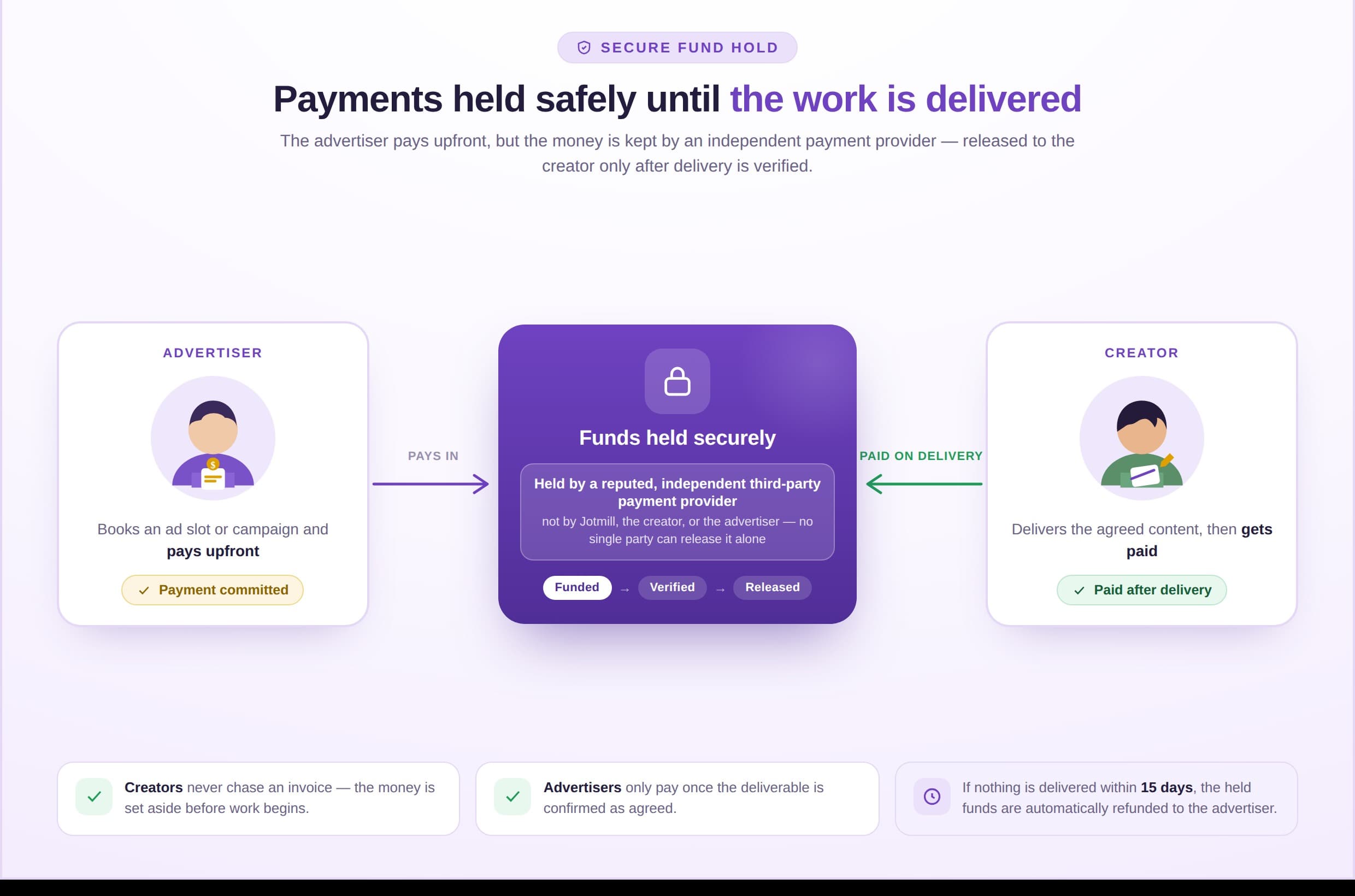
Quick Answer: Jotmill is a digital publishing platform that connects creators and advertisers across multiple content formats, with a secure temporary secure fund hold designed to protect payments during paid collaborations. Jotmill's temporary secure fund hold is a payment safeguard built into every paid deal on the platform. When an advertiser books an AD (advertisement) slot sale or advertiser’s campaign, their payment moves into a temporary hold with a regulated third-party payment provider not to Jotmill, and not to the creator. The money stays there until the creator delivers the agreed content and Jotmill confirms it matches the deal. Only then is it released. This protects creators from unpaid work and protects advertisers from paying for content that never shows up.
Why Payment Trust Matters on a Creator Platform
Every paid deal between a creator and an advertiser has the same problem: someone has to go first.
If the advertiser pays upfront, they're trusting a creator they may have never worked with to actually deliver. If the creator publishes first and sends an invoice after, they're trusting a brand to pay once the content already exists and once it exists, the creator has no leverage left.
This isn't a small, occasional issue. Late or unpaid invoices are one of the most common complaints creators raise about brand deals. On the other side, advertisers regularly report campaigns that go live late, don't match what was pitched, or never go live at all. Both groups are describing the same root problem from opposite sides: there's no built-in checkpoint that confirms a deal was honored before money changes hands.
Most freelance ad deals the kind done over email and invoices just pick one side to take the risk. Jotmill's temporary secure fund hold removes that trade-off entirely.
What Is Jotmill's Temporary Secure Fund Hold?
The temporary secure fund hold is a holding step for advertiser payments. Instead of sending money straight to a creator, or letting Jotmill hold it internally, the funds go to a regulated third-party pa--yment provider the moment a deal is booked. Neither Jotmill, the creator, nor the advertiser can unilaterally release or claw back that money. It stays parked until the agreed work is delivered and verified.
This isn't a new idea. Holding funds until agreed conditions are met is a well-established practice in real estate, freelancing, and online marketplaces, where a neutral party keeps money safe until both sides meet their end of the deal. Jotmill applies that same logic to creator and advertiser deals, built directly into how ad slots and campaigns are booked.
Who This Applies To
Jotmill supports a wide range of creators and content types, and the secure fund hold works the same way across all of them:
• Writers publishing articles, essays, and stories
• Visual content creators sharing memes, illustrations, posters, and cartoons-
• Podcasters hosting audio only episodes and sponsored segments
• Video content creators uploading clips, shorts, and longer sponsored features
• Subject matter experts publishing guides and commentary in a niche
Advertisers can book placements across any of these formats, sometimes running a single-format campaign, sometimes combining several in one push. A written article and a video series don't take the same effort to produce, but they get the same level of payment protection.
Advertisers work with creators on Jotmill in two ways:
1. AD Slot Sale: buying a slot inside a creator's existing, pre-published content directly from the marketplace.
2. Advertiser’s AD Campaign posting a campaign with a budget, and letting creators submit proposals to bid on it.
Once an advertiser picks a creator through either route, the same secure fund hold process kicks in.
How the Temporary Secure Fund Hold Works, Step by Step
Buying an AD Slot
1. The advertiser books the slot and pays. Payment is collected immediately, along with the ad banner or clip the advertiser wants placed. That money does not go to the creator yet it moves into the temporary secure fund hold with the third-party payment provider.
2. The creator delivers. The creator places the ad inside their existing content, on the timeline agreed at booking. The content stays visible to the creator's readers, listeners, or viewers as usual.
3. The advertiser verifies delivery. Using their dashboard, the advertiser checks the finished placement against what they booked format, position, and timing. Delivery is also tracked through views, listens, reads, or engagement, depending on the content type.
4. Funds are released. Once verification is complete or once the review window set in Jotmill's terms passes without a dispute the held funds move automatically to the creator.
Bidding on an Advertiser's Campaign
1. The advertiser creates a campaign. They set a budget and invite creators to submit proposals covering content format, audience, delivery approach, and pricing.
2. The advertiser selects a creator. Once bidding closes, the advertiser reviews proposals and awards the campaign. Timeline, deliverables, and completion terms are agreed at this point.
3. Payment moves into the secure fund hold. The full agreed amount is paid upfront by the advertiser, but it isn't released to the creator yet it goes into the same temporary hold with the third-party provider. Both sides can track its status: Funded, Verified, Released.
4. The creator delivers the work. This could be a blog post, video, podcast episode, or campaign, matching the scope and format agreed when the campaign was awarded.
5. The advertiser verifies the deliverable. The advertiser checks the submission against the original campaign requirements through their dashboard.
6. Funds are released or the deal times out safely. Once the advertiser confirms the work meets the agreement, funds release to the creator. If the advertiser doesn't respond within the review window, Jotmill releases the funds automatically so the creator isn't left waiting. If there's no delivery or activity at all within the platform's 15-day project limit, the funds are automatically refunded to the advertiser instead.
That last safeguard matters: the temporary secure fund hold protects both directions. Creators aren't left chasing payment, and advertisers aren't left funding a deal that never happened.
How This Protects Creators
For creators, the temporary secure fund hold changes the entire relationship with advertisers:
• Payment is committed before the work starts, not promised after.
• There's no need to chase an advertiser for an invoice.
• Creators can take on ad-supported work without financial risk, even with a brand they've never worked with before.
• Every deal leaves a paper trail showing the funds were already set aside.
This matters most for creators who depend on ad income as a steady part of their earnings — full-time writers, podcasters, and video creators publishing on a regular schedule.
How This Protects Advertisers
Advertisers get an equally important, different set of protections:
• Money is only released after the deliverable is confirmed, or after a fair review period passes.
• There's no risk of paying for content that never gets published.
• The verification step creates a clear, checkable record of every ad slot sale or campaign.
• If a creator doesn't deliver at all, the funds are automatically refunded rather than sitting in limbo.
For a business spending real money on a campaign, this turns a leap of faith into a controlled, trackable transaction.
What the Secure Fund Hold Isn't
Worth being precise, since "secure fund hold" can sound like a few different things:
• It's not Jotmill holding your money in an internal balance; the platform controls it's handled by a regulated third-party payment provider outside the platform, so no single party has unilateral control over release.
• It's not something you manually request release from after every deal release is tied to delivery verification or the review window, so in the normal case, nobody has to chase anybody.
• It's not a guarantee against every possible disagreement disputes are resolved through Jotmill's support before funds move. What it removes is the default risk of non-payment or non-delivery, not every disagreement about creative quality or targeting.
Why This Fits Today's Creator Economy
More advertisers are shifting ad spend away from traditional media and toward creators, podcasters, and independent publishers. Traditional media buys go through agencies and contracts with multi-stage commissions. Creator deals often happen fast, over direct messages or email, with far less structure behind them. That speed is appealing, but it raises payment risk and higher commissions with impact on both sides.
The temporary secure fund hold is Jotmill's answer to that problem. It keeps the process fast while still giving each party something to rely on which lowers the barrier for advertisers testing creator partnerships for the first time, and gives creators the confidence to say yes to brands they've never worked with before.
What This Means, Practically
If you're a creator: you can say yes to a brand you've never worked with before without wondering whether you'll get paid once the work is done. That changes which deals you're willing to take, especially early on when you don't have leverage or a track record yet.
If you're an advertiser: you can book a creator you've never worked with before without wondering whether the content will actually go live as agreed. That lowers the bar for testing a new creator relationship which is exactly the friction that's been holding advertisers back from working with creators across formats like newsletters, podcasts, video, and visual content.
Tips for Getting the Most Out of the Secure Fund Hold
For creators:
• Confirm the exact deliverable details before accepting a deal — length, format, and due date.
• Deliver in the format and timeline agreed at booking. Even small mismatches can delay verification.
• Keep your own record of what was published and when, as a backup to Jotmill's verification log.
• Reach out early if a deadline needs to shift, rather than staying quiet until it's already missed.
• Read the brief twice before accepting. Most delivery mismatches trace back to an assumption made early on.
For advertisers:
• Write clear, specific requirements at the time of booking, down to format and placement.
• Upload the right ad banner or clip during the purchase step, matching the content type agreed.
• Review the verification confirmation once content is published, rather than assuming everything matched.
• Communicate directly with the creator if requirements change mid-deal, instead of adjusting expectations silently.
• Give creators a reasonable turnaround. Rushed deadlines are one of the most common causes of mismatched deliverables.
What Happens After a Deal Closes
Once a deal wraps up and funds are released, both sides keep a record of it. Creators can look back at past deals to see payment history, turnaround times, and which advertisers they've worked with. Advertisers can do the same building a track record of which creators consistently deliver on time and as agreed.
Over time, that record becomes useful beyond the individual deal. A creator with a strong delivery history builds credibility that makes future advertisers more comfortable booking bigger campaigns. An advertiser with a clean, on-time payment history becomes a more attractive partner for creators choosing who to work with. The temporary secure fund hold isn't just solving a one-time payment problem, it's building the track record that makes Jotmill easier to trust the longer someone uses it.
Frequently Asked Questions
Does Jotmill hold advertiser payments directly?
No. Funds are held by a regulated third-party payment provider outside the platform, not by Jotmill itself, so no single party has unilateral control over when money is released.
When does a creator actually get paid?
Once the ad has been published as agreed and delivery is verified through tracked views, listens, reads, or engagement, depending on the format funds are released from the hold to the creator.
What happens if there's a dispute over delivery?
Disputes are resolved through Jotmill's support before any funds are released, so an advertiser's payment stays protected until the disagreement is settled.
How long does the temporary secure fund hold last?
Up to 15 days from the moment an ad slot is purchased or a campaign is funded, until the deliverable is confirmed. The goal is always to release funds as soon as the work is verified.
What happens if a creator never delivers?
If there's no delivery or documented progress within the 15-day project window, Jotmill automatically refunds the held funds to the advertiser.
Does the secure fund hold work the same for an AD Slot Sale and advertiser’s campaign bidding work process?
Yes. Whether an advertiser bought a listed slot or awarded a proposal on a campaign they posted, the same temporary secure fund hold process applies once the deal is agreed.
Does the temporary secure fund hold extra?
No. It's built into how every ad slot or campaign is booked on Jotmill, not a separate service creators or advertisers need to sign up for.
The Secure Fund Hold Isn't the Flashy Part It's the Part That Makes Everything Else Work
Ad slot marketplaces, campaign bidding, working with people you've never met none of it functions well without a mechanism that removes the need for blind trust on either side. That's what the temporary secure fund hold is doing quietly in the background of every deal on Jotmill.
Ready to see it in action? Create a creator account to list your first slot, or start a campaign as an advertiser to work directly with creators across every content type.
Sell ad slots on your own terms
List slots on your videos, podcasts, blogs or cartoons, set your own prices, and get paid through a fund-hold that protects you and the advertiser.